Rock Paper Shoot is a rock paper scissors game you play with your real hand in front of a webcam. It has three ways to play, and they feel surprisingly different: a best-of-five duel against a computer opponent that tries to read you, a reflex test where the computer throws first and you have to answer correctly before a timer runs out, and online rooms where you play rock paper scissors with friends on a shared beat. This guide walks through each one, who it suits, and the details that keep every mode fair.
If you are new to the game, how the hand tracking works is covered separately. The short version: your webcam finds 21 points on your hand, the game decides from the finger shapes whether you are showing rock, paper or scissors, and nothing leaves your device.
Classic Duel: rock paper scissors against the AI

Classic Duel is the rock paper scissors duel mode most people start with. A cartoon opponent with a giant glove counts you in — “Rock… Paper… Scissors… SHOOT!”, one word every 0.6 seconds — and you both throw on SHOOT. It is best of five: the first to three round wins takes the match, and ties do not count towards the score. A match usually lasts a minute or two.
What makes it more than a random-number generator is that the opponent plays like a person. It commits to its throw 100 ms before SHOOT, and in the moments before that it is watching your hand:
- If your hand already shows paper or scissors (anything except the pumping fist), it believes what it sees and throws the counter.
- If you bluffed it last round — showed one shape early, then threw another — and you show that same early shape again, it expects the same trick.
- If your hand gives nothing away, it uses habits: you tend to repeat a throw that just won, to switch after a loss to whatever beats its last throw, or to lean on your most-played throw.
- It only trusts its read about 70% of the time; otherwise it throws at random, so it never becomes unbeatable.
This turns the duel into a little game of bluff. Keep your fist closed through the count-in and you give it nothing. Flash a fake shape early and you can steer its counter — once. It trash-talks along the way, too: a read that worked gets a “Telegraphed it!”, and a repeated bluff gets “Fool me once…”.
Reflex mode: rock paper scissors in reverse

Reflex mode flips the game around. The glove throws first, and a command appears with it: BEAT IT, LOSE TO IT or TIE IT. The whole scene’s light changes colour to match — green for beat it, red for lose to it, yellow for tie it — so you can read the order without reading the words. You have to show a throw that satisfies the command before the timer runs out.
- The answer window starts at 0.9 seconds and shrinks by 45 ms with every correct answer, down to 0.35 seconds.
- The pause before each reveal is randomised, so you cannot anticipate the rhythm.
- You have three lives. A wrong throw or a late one costs a life.
- You must throw after the reveal. Holding a fist through the whole run does not answer every “tie rock” for you — if your hand has not changed since the reveal, the game calls it “Frozen!”.
- Answers faster than 90 ms are treated as guesses rather than reactions.
“Lose to it” is the one that catches everyone: your brain has spent its whole life trying to win at rock paper scissors, and asking it to lose on purpose under time pressure is surprisingly hard. Your score is the number of correct answers before your third miss, and it goes on the Reflex leaderboard, along with your fastest and average reaction time at the end of each run.
Multiplayer rock paper scissors online with friends
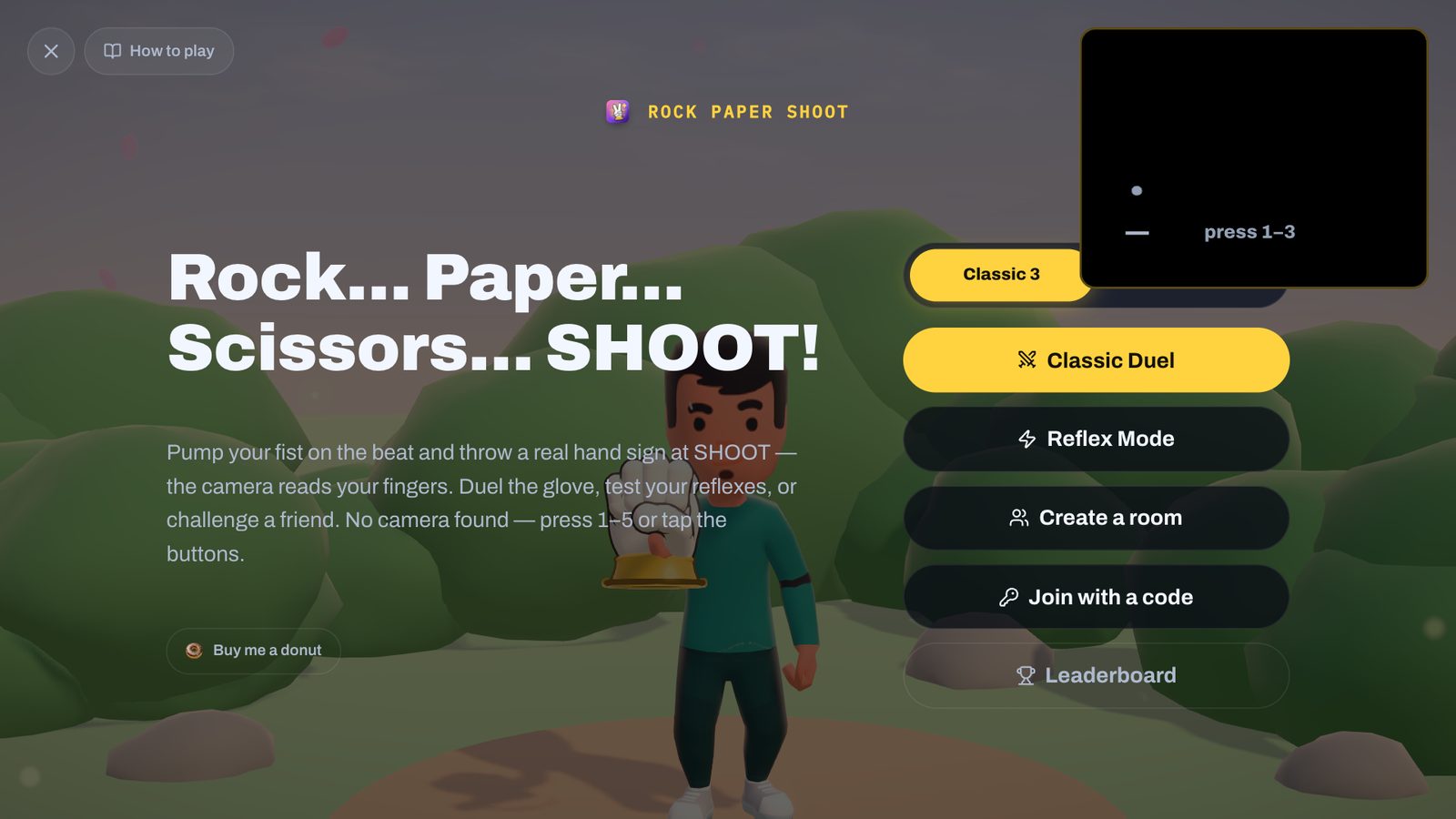
The online mode is the one to reach for when you want to play rock paper scissors with friends online — someone across the table on another laptop, or across the world. It uses the Classic Duel rules (best of five, first to three) but with a person on the other side.
- One player creates a room. The game gives you a short room code and a “Copy invite link” button.
- Your friend either types the code into Join, or just opens the invite link, which drops them straight into the room.
- A duel seats two players. Once your challenger is in, the room creator starts the duel and both screens count down together.
- The room creator also picks the rules for both players: Classic (rock, paper, scissors) or Lizard-Spock (all five).
- When the match ends, you can play again in the same room.
You do not need an account to play online: the game signs you in as a guest automatically. Each player needs their own device with a webcam, because each camera tracks one hand.
How the online duel stays fair
Simultaneous reveal is the whole point of rock paper scissors, and it is the hardest part to get right over the internet. If one player saw the other’s hand first, they could simply switch. Rock Paper Shoot handles this in a few ways:
- Shared beat. Both players count in from the same server-agreed start time, and every round sits on a fixed schedule from that start, so the two screens do not drift apart over a match.
- Each player is judged on their own device. Your camera reads your throw locally and locks it a quarter of a second after SHOOT; only the result (“paper”) is sent to the room, never the video.
- Nobody sees anything early. The opponent’s hand is only revealed once both locked throws have arrived, so there is nothing to react to.
- The same anti-switch rule as solo. Changing to a different throw more than 120 ms after SHOOT is a foul — “Too slow!” — and a foul loses the round.
- No stalling. If a throw has not arrived 2.2 seconds after SHOOT, it counts as no throw, so a dropped connection cannot hold the match hostage.
This matters because it means a slow connection only delays the reveal; it never gives the faster player an advantage. The same idea — judge each player locally, share only the outcome — is what keeps CamPlay’s other multiplayer games fair, like online Simon Says for family game night.
Which mode should you play?
| If you want… | Play |
|---|---|
| A quick match on your own | Classic Duel — a minute or two, best of five |
| To outsmart an opponent with bluffs | Classic Duel — it reads early shapes and habits |
| A pure reaction test and a high score | Reflex — three lives, shrinking timer, leaderboard |
| To settle an argument with a friend | Online duel — invite link, simultaneous reveal |
| More variety | Any of the above with Lizard-Spock switched on |
A good session is a couple of Classic Duels to warm up your hand shapes, a few Reflex runs to chase your best score, then an invite link to a friend. If you fancy the five-gesture version, read how to play rock paper scissors lizard Spock online first — the Spock and lizard shapes take a few tries. Ready? Start a duel.